
Commercial resin driveway cleaning: Recycling and Sustainability Commitment
Our approach to commercial resin driveway cleaning integrates an eco-first mindset across every site. From the initial assessment to the final sweep, we prioritise an eco-friendly waste disposal area and a purpose-built sustainable rubbish gardening area at commercial premises. These measures ensure that resin drive maintenance for businesses reduces waste, diverts materials from landfill and supports local circular-economy initiatives.As specialists in resin drive cleaning for businesses and organisations, we combine industry best practice with local boroughs' approaches to waste separation — for example, separating dry recycling, food waste, glass and garden waste at source where municipal rules require. Our teams are trained to work with these local systems so the materials we collect can follow the correct stream at transfer points.
Practical steps we take on-site
When delivering resin driveway maintenance services, we create an on-site collection and sorting routine that reduces contamination. We aim to meet a publicised recycling percentage target of 75% of all non-hazardous clean-up materials within the first 12 months of implementation, moving to 85% within three years as the programme scales. These targets reflect realistic diversion rates for commercial cleaning waste streams and help measure progress.Key recycling activities relevant to our service area include segregating resin particles, reclaimable grit and stone, clean plastics from packaging, and organic garden residues. We work with local transfer stations that accept segregated loads, including borough-managed transfer depots and regional materials recovery facilities. That close coordination reduces double-handling and carbon costs.
How we manage recyclable outputs
- Collected inert aggregates and reclaimed stone are channelled to aggregate reprocessors or used as subbase where permitted.
- Mixed dry recyclables such as plastics, paper and cardboard are taken to borough transfer facilities aligned with municipal sorting rules.
- Organic garden waste is diverted to municipal composting where available or to local AD (anaerobic digestion) sites that accept green waste.
- Any hazardous residues are contained, recorded and delivered to authorised waste transfer stations for specialist treatment.
We maintain detailed waste transfer documentation and use auditing to verify our recycling percentage target progress. Working with borough councils, our teams adapt to local waste separation variations: some boroughs operate four-stream kerbside systems while others use regional consolidation points for commercial loads.
Partnerships with charities and community organisations are central to our reuse strategy. Salvageable materials — such as clean paving stones, edging blocks and surplus topsoil from a sustainable rubbish gardening area — are offered to local non-profits and community gardening projects. These partners often repurpose materials for raised beds, landscaping for schools, or habitat restoration, reducing the need for virgin materials.
We also collaborate with local reuse centres and social enterprises that accept building and landscaping offcuts. By donating suitable materials, we create measurable social and environmental benefits, while keeping recoverable items in circulation. These charity partnerships are tracked in our quarterly sustainability reports so each donation is accounted for in diversion statistics.

Low-carbon logistics and fleet choices
Our commitment extends to transport: low-carbon vans and efficient routing are standard for our resin drive cleaning teams. We operate a mixed fleet of electric vans and low-emission hybrids, and where EV charging is not feasible we use Euro 6 vehicles with particulate filters. Route optimisation software reduces mileage, and consolidation of loads to local transfer stations lowers total emissions per tonne of material moved.The dedicated eco-friendly waste disposal area on-site includes spill containment measures, labelled bins for each waste type and impermeable surfaces to prevent runoff. These controlled zones are designed to protect soil and groundwater, and are sited close to the working area to minimise material handling. For resin driveway maintenance, this protects the environment during slurry capture and aggregate separation.
Specific recycling activities we regularly perform in boroughs across our operating area include screening and re-using cleaned gravel, depositing clean timber to community wood-reuse schemes, and redirecting packaging to municipal recycling centres. We adapt to the differing borough guidance: some councils prefer commercial waste to be pre-sorted before arrival at transfer stations, which we incorporate into our on-site processes.
Monitoring and continuous improvement underpin our approach: we compile monthly data on volumes diverted, quantities donated to charities, and transport emissions. Our long-term sustainability aim is to raise the waste diversion rate to 80% by 2030, while steadily decarbonising the fleet and expanding partnerships for reuse.
Community engagement and staff training We invest in training operatives on waste segregation, safe handling of any hazardous residues and the practicalities of creating a sustainable rubbish gardening area. Our staff are briefed on local borough separation guidelines so they can adapt drive cleaning procedures to match council expectations and optimise recycling outcomes.
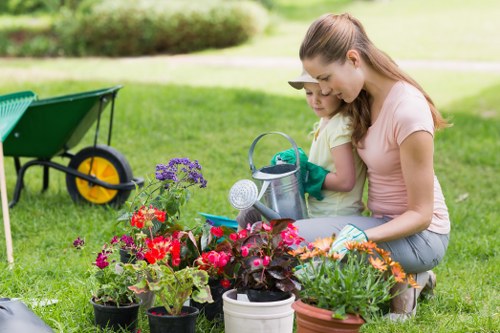
 The sustainable rubbish gardening area is more than a disposal point: it becomes a resource. Compost derived from green waste and mulch from reclaimed woody material are used to enrich planting strips, support biodiversity borders and stabilise verges. Surplus topsoil and stone may be redirected to community landscaping projects via partners, ensuring materials remain in productive use rather than being sent to landfill.
 In summary, our commercial resin driveway cleaning and resin drive cleaning services combine practical on-site waste separation, collaboration with local transfer stations and charities, a clear recycling percentage target, and a low-carbon vehicle strategy. These integrated measures create resilient, replicable models for eco-friendly waste disposal areas and sustainable rubbish gardening areas at commercial sites — delivering cleaner drives and a healthier environment for the communities we serve.